
Concrete Cleaning in Brunswick, GA: Sidewalks, Steps, Porches and Walkways
A lot of the concrete on a Glynn County property isn't the driveway—it's the front walk, the steps up to the door, a porch slab, the garage apron, a stretch of curb.
Call (912) 571-0639 for a Free QuoteThat flatwork usually sits in more shade than the drive, so it holds moisture longer and turns green first. We clean it the same way we clean a drive—pre-treated, then run with a rotary surface cleaner for an even finish—but it's priced and scheduled as its own job. The driveway itself has its own page for cleaning the drive surface.
What Counts as Concrete Cleaning on a Brunswick Property
The flatwork on a typical Glynn County property adds up fast. A front walk from the street to the door. Two or three steps and a landing. A porch slab. The apron where the garage floor meets the drive. A back patio slab. A stretch of curb and gutter pan along the street. On a small commercial exterior, it's the sidewalk out front, the entry landing and the pad by the back door.
All of that is this job.
The driveway isn't. The poured concrete, pavers, brick or exposed aggregate that makes up the actual drive gets quoted and cleaned as its own job, with its own page. That's a scope line—a two-car drive is a different amount of surface and a different amount of time than a front walk and three steps.
A pool deck isn't this job either, even when it's plain poured concrete. Anything around pool water runs under a separate water-protection protocol, and screened lanais and pool cages come with it—a different job with its own scope.
Our truck starts at 1136 Autumns Wood Cir on the north side of Brunswick, off the Golden Isles Parkway. Flatwork in town, out toward Sterling, in Dock Junction and Country Club Estates, and across the Torras Causeway on the islands—all on the regular route.
Why a Shaded Walkway or Step Turns Green Faster Than the Rest of the Yard
Humidity on this part of the coast sits above 70 percent most of the year, Brunswick takes roughly fifty inches of rain, and the winters are too mild to knock algae back the way a hard freeze does farther north. Concrete in the open dries between rains. Concrete in shade doesn't.
That's the whole mechanism. Green algae needs a surface that stays damp, and a walkway under a canopy gives it one for most of the year. The EPA's guide to mold and moisture puts it the same way: moisture is what growth runs on.
In Old Town, live oaks like Lover's Oak on Albany Street keep the old grid shaded all day. Leaf tannin from those oaks bleeds onto concrete with every rain and stains it dark within a season—so a walk under heavy canopy goes from gray to green to near-black without anybody doing anything wrong.
Sterling sits low with heavy tree cover along US 341, six minutes from the shop. Low elevation and flat drainage mean water sits, and flatwork there stays wet longer after a storm than the same slab would on higher, open ground.
Azalea Gardens near Glynn Place Mall carries a heavy pollen load. Late February through May, the oaks and pines coat every walk, step and porch yellow, and that pollen film is what the algae starts on once the spring rain comes.
Broadfield, off US 17, is different. Those homes were built since 2000 and mostly need routine upkeep rather than a decade of built-up growth—a walkway and apron that see one pass a year instead of a deep clean.
A green step isn't only a looks problem. Algae on a wet step is slick, and steps are where people fall.
Cleaning it doesn't end the cycle. The coastal conditions that grew it are still here after we leave, and growth comes back on a schedule set by how much shade and how much water that particular slab gets. What a proper clean buys is a surface that starts over from bare concrete instead of layering another season on top of the last one.
The Rotary Surface Cleaner: An Even Clean With No Wand Stripes
Concrete is one of the few surfaces on a house that can take real pressure. It gets it.
Before any water touches the field, the concrete is pre-treated with a cleaning solution and given dwell time—and that step matters more than the pressure does. Algae has roots into the pores of the concrete. A water-only spray takes off the top layer of green while leaving what's underneath alive to grow straight back. Pre-treatment kills it at the root, which is why a pre-treated slab holds its clean longer than one that was only blasted with water.
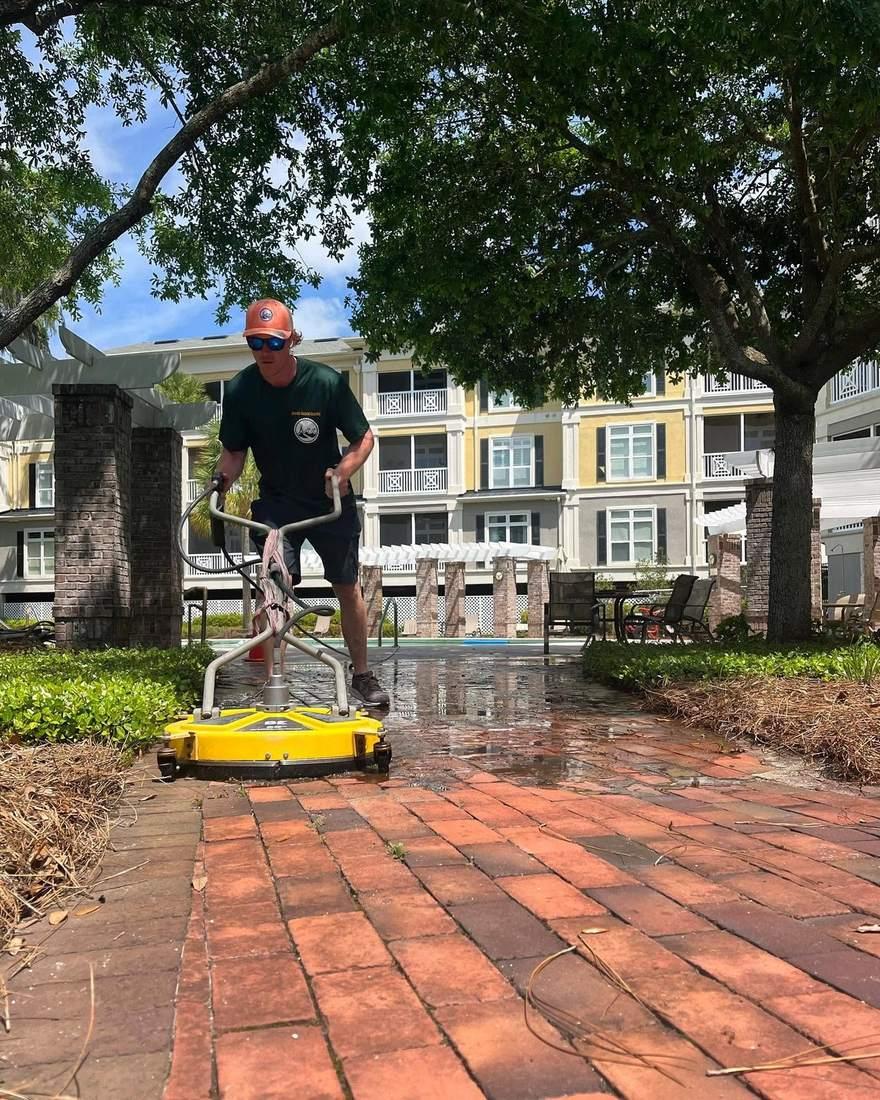
Then the field gets run with a rotary surface cleaner: a shrouded head with bars that spin underneath it, so the water hits the slab at a consistent distance and a consistent speed across the whole surface. That's what produces an even finish from one edge to the other.
A wand held in a hand can't do that. The tip sits closer in some passes than others, the operator's arc slows at the end of each sweep, and the result is pale stripes and arcs baked into the concrete that show up worse once it dries. Those wand stripes don't come out. The only fix is cleaning the whole slab again, evenly.
The wand still has a job here, just a narrow one—edges the surface cleaner can't reach, expansion joints, corners where the slab meets a wall or a step riser, individual stains that need direct attention. Field work is the surface cleaner. Detail work is the wand.
Same method as a driveway, just applied to smaller and more awkward pieces of flatwork—which is why a stack of steps takes longer per square foot than an open patio slab does.
What Not to Clean Concrete With: Brick, Painted Porches and Exposed Aggregate
Most flatwork jobs aren't one material. A concrete walk runs up to a brick landing. A porch slab's been painted. A patio is exposed aggregate instead of a smooth pour. Each of those gets handled on its own terms during the same visit—because the setting that's correct for the concrete field is wrong for what borders it.
Brick walks and aprons. Old Town has older brick walks and driveway aprons, set in lime mortar. Brick is softer than it looks. Pressure pits the face and blows the mortar out of the joints. Brick gets treated the way siding is treated: cleaning solution first, dwell time, then a gentle rinse with a wide fan tip. No surface cleaner.
Painted concrete porches. Around Howard Coffin Park, in Windsor Park and Urbana, painted concrete porches are common on the older brick and painted wood homes. Paint on concrete is a coating, and pressure gets under it and lifts it, so painted porch slabs are soft washed—same as painted wood siding, low pressure and the right solution, so the paint stays on the porch.
Exposed aggregate. The stones in an exposed aggregate slab are held by the cement matrix around them, and a careless wand pops them loose, leaving pockmarks that can't be put back. Surface cleaner and detergent only. No wand on the field.
Plants get protected before anything else happens. Beds, hedges and grass along a walkway, a porch or a curb line are soaked with water before the solution goes on, then rinsed again after. A cleaning solution left sitting on foliage burns it.
Honest Results: What Comes Out and What May Only Lighten
Here's what a pre-treated, surface-cleaned slab actually looks like afterward.
Green algae comes out. Black mildew comes out. Leaf tannin staining from the oaks comes out. Pollen film, mud splash, general dirt—all of it comes out. On most walks, steps and porch slabs in this county, that's the entire problem, and the concrete goes back to the color it was poured in.
Some things aren't dirt, though, and they behave differently.
Orange rust from well-fed irrigation is everywhere in coastal Georgia, and it doesn't respond to pressure at all—you can run a surface cleaner over a rust stain until the concrete is wet through and the orange is still sitting there. Rust needs a rust remover made for concrete, applied by hand to the stain. Fresh rust generally comes out. Rust that's been feeding on the same spot for years may only fade.
Oil is the same kind of problem. An oil stain by a garage door has soaked down into the pores, so a degreaser and hand work lift what's in the top of the slab. A deep, old stain often leaves a ghost.
Etching works differently. Where minerals or a harsh chemical have eaten into the surface of the concrete, the concrete itself is a different texture there—and no amount of cleaning changes texture.
We tell customers which of those they have before the job starts. If your walk is green, you're getting a clean walk. If your apron has an old oil stain in it, you're getting a much better apron with a shadow where the stain was—and it's better to hear that at the quote than to pay and be surprised.
What Moves the Price on a Concrete Cleaning Job
There's no published price for concrete cleaning, and we won't guess one before someone's looked at the property. What moves the number: total square footage of flatwork, how many separate areas get bundled into one visit, how heavy the growth is, whether there's rust or oil staining that needs hand treatment, and access—steps, tight side yards, gates, furniture or planters that have to be moved. The quote is free and written, given after a walk of the property, with no charge for the visit.
Bundling is the part homeowners underestimate. A walkway, a set of front steps and a porch slab scheduled together on one visit is one setup, one hose run, one trip. The same three areas booked on three different days is three of everything.
Once we give you a number, that number is the job. It doesn't change after we start—unless we find something we couldn't see from the walk-through, and then we tell you and you approve it before we go any further.
For the driveway itself, how driveway cleaning costs are figured is laid out on its own page, with its own set of factors.
What's Separate: the Driveway, the Pool Deck and What We Don't Do
Three boundaries, stated plainly.
The driveway surface itself is a separate job, quoted separately, with its own page. It's usually the largest single piece of flatwork on a property, and it's priced that way.
A pool deck, screened lanai or pool cage is also separate, even when the deck is plain poured concrete. Work around pool water runs under its own water-protection protocol, its own job, its own page.
We don't seal concrete or pavers. Not as an add-on, not at all.
Atlantic Coastal Cleaning is veteran owned and owner operated. Devon Swanson and Levi Greene own the company and are on every job themselves—the person who answers the phone quotes the job, and the person who quotes the job is the one running the surface cleaner on your walkway. Nothing is subcontracted. We're licensed and insured.
If a job's not clean to your satisfaction, we come back and re-clean it at no charge. No callback fee. No argument.
Frequently Asked Questions
How much does it cost to clean a sidewalk, steps or porch slab in Brunswick?
There's no set price because concrete cleaning covers everything from a short front walk to a full sidewalk, steps and porch scheduled together, and each combination changes the amount of surface and time involved. What actually moves the number is total square footage, how heavy the algae or staining is, whether rust or oil needs hand treatment, and access such as steps or a tight side yard. Atlantic Coastal Cleaning gives a free written quote after walking the property, with no charge for the visit.
How do you make old, stained concrete look new again?
Most of what makes old concrete look new again is removing the algae, mildew and tannin sitting on the surface, not repairing the concrete itself. A slab is pre-treated with a cleaning solution that kills algae at the root, then run with a rotary surface cleaner for an even finish edge to edge. Green algae, black mildew, tannin staining and pollen film come out completely; rust, oil and etching are different problems that may only lighten rather than disappear.
Why don't you use a pressure washing wand to clean the whole slab?
A hand-held wand isn't used across the open field of a walkway, patio or step because the tip sits closer in some passes than others and leaves pale stripes that don't come out once the concrete dries. A rotary surface cleaner runs across the field instead, holding a consistent distance the whole way. The wand is kept for edges, expansion joints and corners the surface cleaner can't reach.
Do you need to be home for a walkway, steps or porch cleaning?
No, you don't need to be home for exterior flatwork like a walkway, steps or porch slab, as long as gates are open and any pets are put away. Most customers just text a few photos and get a written quote back before a truck ever shows up. Evenings and weekends are often available for the walk-through itself.
Will you clean the driveway at the same time as the walkway and steps?
Yes, both can be scheduled on the same visit, but they're priced as two separate jobs, not one. The driveway is usually the largest single piece of flatwork on a property and has its own page and its own quote. Bundling everything into one visit means one setup and one trip instead of two, with each area still on its own line.
How often does a shaded walkway or porch need to be cleaned on the Georgia coast?
It depends on how much shade and standing moisture a particular slab holds, not on a fixed calendar. A walkway under heavy live oak canopy in Old Town or a shaded stretch of Sterling holds humidity longer and turns green sooner than the same slab in full sun, so how fast growth returns is the real guide, not a set interval.
Get a free quote
(912) 571-0639Call or text (912) 571-0639 for a free written quote. There's no charge for the visit, and the quote is written before anything starts.
Atlantic Coastal Cleaning
Veteran owned & operated. Licensed & insured. Pressure washing, soft washing, roof, gutter and window cleaning across Brunswick and the Golden Isles.
★★★★★5.0 across 47 Google reviews
Call (912) 571-06391136 Autumns Wood Cir, Brunswick, GA 31525(912) 571-0639acc@atlanticcoastalcleaningllc.com
Services

Call Us Today

Email Us

Office Location
1136 Autumns Wood Cir, Brunswick, GA 31525


