
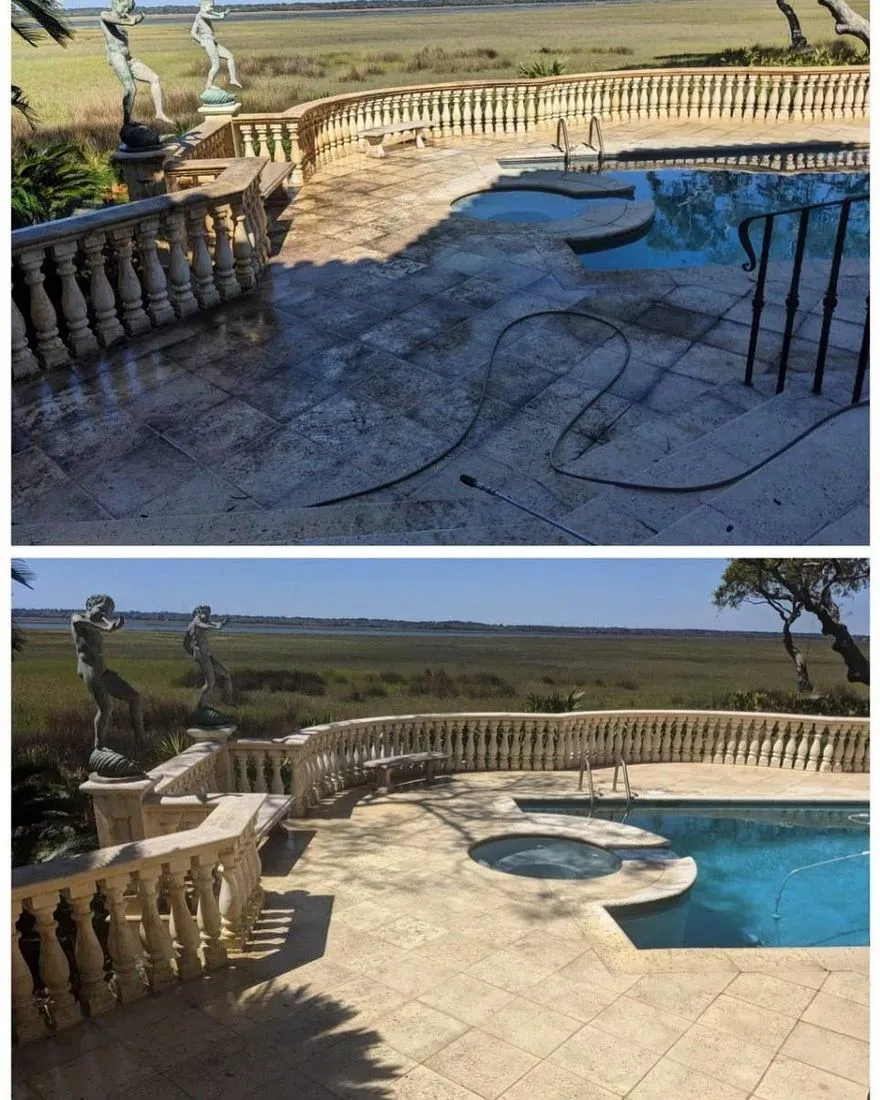
Pool Deck Cleaning in Brunswick, GA
Step out of the pool onto a deck that's slick right at the coping and you already know the problem before you look down: the green band that comes back a week after you hose it.
Call (912) 571-0639 for a Free QuoteThat ring is algae, not dirt, and it grows exactly where a pool deck stays wettest — which is why hosing it off never lasts. Cleaning it right means matching the pressure and the cleaner to the exact surface at the water's edge, and keeping every drop of runoff out of the pool itself. Atlantic Coastal Cleaning is veteran owned and operated and licensed and insured: Devon Swanson and Levi Greene own the company and are the ones on the job, so the person who quotes your deck is the person cleaning it.
Why a Pool Deck Rings Up Green at the Coping
That slick band at the water's edge is algae and mildew growth. Not dirt, not a stain you failed to prevent. It grows where the surface stays wet longest, and around a pool that is always the coping and the first foot or two of deck: splash-out, wet feet, a surface that never gets a chance to dry between swims.
Brunswick gives it everything it needs. Humidity sits above 70 percent most of the year, the town takes roughly fifty inches of rain, and our winters are too mild to knock the growth back the way a hard freeze does farther north. Freezes here are rare and short. Whatever is growing in September is still alive in February.
Shade finishes the job. A deck under live oaks or tucked against the north side of the house never fully dries, and the same canopy drops leaf tannin that stains the concrete dark within a season. The EPA's guidance on mold and mildew comes down to one thing that applies just as much outdoors as in: moisture is the control. Outside, in this climate, you do not get to control it.
So the honest version is this. We clean the deck, kill the growth at the root, and the surface comes back to its real color. In a humid subtropical climate, it will eventually start over — anyone telling you otherwise is setting you up for a complaint.
The island pool season runs roughly April to October, and spring, before the first swim, is the window for this work. Getting it done then means the deck is clean going into the months you actually use it.
A Slick Pool Deck Is a Safety Problem, Not Just a Look
A green pool deck is a slip risk. Around a pool, a slip has a hard edge and water to land in. It is one of the things that worries homeowners around here: a slippery deck and somebody going down on it.
Algae is at its most slippery when wet — exactly the condition a pool deck lives in. The band right at the coping, the part that holds water longest, is the part people cross barefoot most often.
In an HOA neighborhood like Windward Acres, off US 341 between Hidden Lakes and Helmich, a community pool sits with the tennis courts on a street everyone walks past. A shared deck that has gone green is a safety issue and a curb appeal issue at the same time.
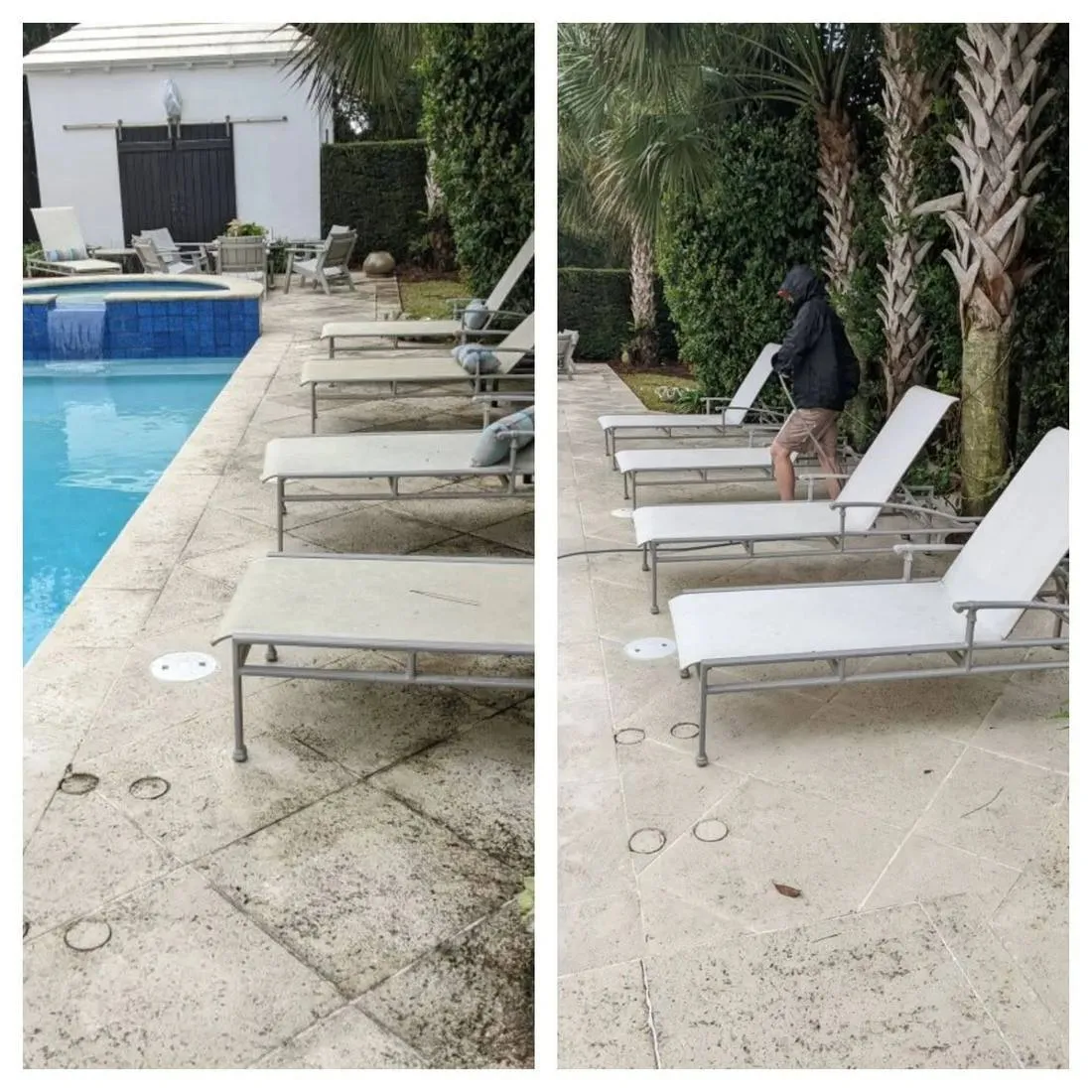
What Actually Moves the Price of a Pool Deck Cleaning
How much does it cost to have a deck cleaned? It depends on a handful of things: the size of the deck, what it is made of (broom-finished concrete, pavers, travertine and cool deck are not the same job), how heavy and how long-standing the growth is, how the access works around pool equipment, furniture and a screen cage, and whether there is irrigation rust or oil staining that has to be treated by hand. We do not price a pool deck over the phone, because the surface and the severity are the job. The quote is free and written, no charge for the visit, one number for the whole job.
Once we start, that number does not change. Unless we find something we could not see on the walk — and then you approve it before we go any further.
How bad the growth is changes the job as much as the size does. A deck behind a newer home in Broadfield, off US 17 where most of the building has happened since 2000, is usually routine upkeep: a season of growth, an annual clean, and it looks after itself. A deck under heavy oak cover that has not been touched in several years takes more time — more dwell time, more work at the coping, on the same surface.
If you want a realistic idea before we come out, a couple of photos can give us a head start — most customers do exactly that — though we still walk the property before the number is written.
Concrete, Pavers, Travertine and Cool Deck Each Take a Different Clean
The method has to match the surface. Four common surfaces sit around pools in Glynn County, and none of them take the same treatment.
Broom-finished and stamped concrete. Concrete can take real pressure. We pre-treat it with a cleaning solution first so the algae is killed at the root, then run a rotary surface cleaner across the field so the deck comes out even edge to edge. The wand only comes out for edges, expansion joints and specific stains — used across the open field, it leaves pale stripes you will see every time the light is low.
Pavers. Pavers get lower pressure than plain concrete, and the reason is the joint sand. The algae lives down in those joints, so the joints have to be cleaned. But pressure that strips the sand out leaves the pavers free to shift. Lower pressure, the right solution, and the sand stays where it belongs.
Travertine. Travertine is common around the newer pools out toward East Beach, and it is a soft, porous stone. No high pressure and no acid cleaner, ever. Salt and algae sit down in every pore, which is why it needs the solution and the dwell time to work.
Cool deck. Cool deck is a brittle textured cement coating over concrete. Pressure chips it, and the chips do not come back — there is no repair that looks like the original surface. It gets gentle treatment, the same as travertine.
The two most common ways a pool deck gets ruined are a wand on cool deck and an acid cleaner on travertine — the materials leave no room for shortcuts.
Keeping the Pool Water and the Plants Around It Out of the Way
The protection happens at the same time as the cleaning.
Solution goes on the deck. It stays off the pool water. The rinse is directed away from the water, so what comes off the deck runs to the yard. If the pool has a cover, it goes on. Afterward, a quick skim handles anything that drifted in.
The landscaping protocol is the same one we run on every job, pool or not. Beds, hedges and grass get wetted down before the solution goes on, and rinsed again after. Wet foliage does not take up solution the way dry foliage does. Brown shrubs around a freshly cleaned deck are the sign of a job done in a hurry.
On marsh-front lots we work from the house side out, so the rinse runs onto the yard, away from the water. The tidal marsh is protected under Georgia's Coastal Marshlands Protection Act. Where the runoff goes matters here in a way it does not twenty miles inland.
You do not need to be home for exterior-only work like this, as long as the gates are open and any pets are put away.
Rust Stains and Paver Joint Sand: Said Straight, Not Oversold
Orange irrigation rust is everywhere in coastal Georgia, because well-fed irrigation puts it on the deck every cycle.
Rust does not respond to pressure. No amount of it. Rust needs a rust remover made for concrete, applied by hand. Worth knowing before we start: very old rust may fade rather than vanish, and if it has been feeding into the same spot for years, do not expect it to disappear completely. We will tell you which one we think you are looking at when we walk the deck.
Oil and grease near a deck get a degreaser. Old oil that has soaked deep into concrete can leave a ghost.
Joint sand gets the same straight treatment. If a paver joint around your pool has already lost its sand, we point it out. The fix is simple and it stops the pavers shifting later.
Where a Pool Deck Job Ends: Screens, Patios and Driveways Are Separate Work
Pool decks sit next to three other surfaces that people reasonably assume are included. They are not.
The screen enclosure or pool cage over the deck is a separate job, quoted and handled on its own — see cleaning a screen enclosure or pool cage for that method. Aluminum frame and fiberglass screen need low pressure from both sides, and pressure in the wrong place tears the screen or pops the spline. Pool cages under the oaks in Sea Palms and along Frederica Road stay damp year round, so it is a common pairing, but it is booked as its own work.
A front patio or a walkway outside the pool area falls under the full patio, pool deck and lanai cleaning service, which covers all three together.
A driveway or any other non-pool concrete is a separate visit, quoted on its own — see driveway and concrete cleaning — even though the surface cleaner and the pre-treatment look much the same from the outside.
House washing, roof cleaning, gutter cleaning, window cleaning and deck and fence cleaning are all separate services too. Bundling several of them into one visit is normal and costs less than separate trips, but each one is quoted as what it is.
Clubhouse and community pool decks can be quoted too.
Frequently Asked Questions
How much does it cost to have a pool deck cleaned?
It depends on the deck, not a flat rate. Cost is set by the deck's size, its surface material — broom-finished concrete, pavers, travertine or cool deck — how heavy the algae growth is, access around pool equipment and any screen cage, and whether rust or oil staining needs hand treatment. We write the number in writing, free, after we've walked the deck.
What kills algae on a pool deck, and will it come back?
Killing algae takes a cleaning solution with real dwell time, not just water pressure. We pre-treat the deck so the algae dies at the root instead of scattering across the surface, then use the pressure and method suited to that material. Brunswick's humidity and shade mean the algae eventually starts over — that's the climate, not a corner cut, so we never promise it won't.
Is pressure washing worth it for a pool deck, or could it damage the surface?
Pressure washing pays off only when it matches the surface — used wrong, it can chip, pit or strip a pool deck for good. Concrete takes real pressure and a rotary surface cleaner to come out even. Pavers, travertine and cool deck do not: pressure strips paver joint sand, pits soft travertine, and chips cool deck's coating — damage with no repair that matches the original surface.
Will the cleaning solution or runoff hurt my pool water or equipment?
No — solution stays on the deck and never reaches the pool water. The rinse is aimed away from the water toward the yard, and if there's a pool cover, it goes on before we start. A quick skim afterward catches anything that drifted in, and beds or grass nearby get wetted down first too, so the solution doesn't burn them.
How often should a pool deck be cleaned in Brunswick?
Spring, before the first swim, is the best window for most homeowners here. Since the island pool season runs roughly April through October, cleaning ahead of it means the deck stays usable through the months you're actually swimming. A deck under heavy oak shade or on a low, marsh-facing lot holds moisture longer and can need attention again sooner than one in full sun.
Can pressure washing get rid of the orange rust stains around my pool?
Pressure alone won't touch orange rust — it needs a rust remover applied by hand. Irrigation rust is common on decks here because well water carries iron that sprinklers put down every cycle. We treat it by hand with a rust remover made for concrete rather than pressure, since pressure does nothing to it. Very old, deep-set rust may fade rather than disappear completely.
Get a free quote
(912) 571-0639We work Brunswick, Dock Junction, Country Club Estates, Sterling, St. Simons Island, Sea Island, Jekyll Island, Darien and north McIntosh County. The truck starts in Brunswick 31525 — six minutes to Sterling on US 341, about fifteen over the Torras Causeway to St. Simons. Call (912) 571-0639 for a free written quote on your pool deck — we'll take a look, write one number for the job, and re-clean it free if it's not right the first time.
Atlantic Coastal Cleaning
Veteran owned & operated. Licensed & insured. Pressure washing, soft washing, roof, gutter and window cleaning across Brunswick and the Golden Isles.
★★★★★5.0 across 47 Google reviews
Call (912) 571-06391136 Autumns Wood Cir, Brunswick, GA 31525(912) 571-0639acc@atlanticcoastalcleaningllc.com
Services

Call Us Today

Email Us

Office Location
1136 Autumns Wood Cir, Brunswick, GA 31525


